Protecting Your Crops: The Science Behind Stress Mitigation and pH Management
Published: December 20, 2025
Category: Agronomy & Best Practices
Reading Time: 8 minutes
Introduction
Herbicide applications are essential for weed control in modern agriculture, but they can also introduce stress to your crops. Understanding how to mitigate this stress while maximizing the effectiveness of your chemical applications can mean the difference between average yields and record-breaking harvests. Recent field research from Beck's Practical Farm Research and agronomic studies have revealed powerful insights into crop safety strategies that every farmer should know.
This article explores the science behind stress mitigation products, the critical role of pH management in pesticide effectiveness, and real-world field trial results that demonstrate measurable yield improvements and return on investment.
Understanding Herbicide Stress on Crops
When herbicides pass through crop canopies or are applied post-emergence, they can cause temporary stress to plants even when applied according to label directions. This stress manifests in several ways:
- Leaf burn or discoloration from chemical contact
- Reduced photosynthesis during the recovery period
- Slowed growth as the plant redirects energy to repair damaged tissues
- Nutrient uptake disruption affecting overall plant health
The severity of herbicide stress depends on multiple factors including application timing, environmental conditions, crop stage, and water quality. However, emerging research shows that liquid carbon-based fertilizers can significantly reduce this stress and help crops recover faster.
The Role of Liquid Carbon-Based Fertilizers
What Are Liquid Carbon-Based Fertilizers?
Liquid carbon-based fertilizers (L-CBF) are specialized formulations that combine readily available carbon with essential nutrients. These products address two critical factors that influence crop stress:
- Low soil pH - which limits nutrient availability
- Available carbon (energy) - which plants need for metabolic processes
One such product highlighted in recent research is BOOST 4-0-3-2S, a liquid-carbon based fertilizer concentrate that provides:
- 4% Nitrogen for protein synthesis and chlorophyll production
- 3% Soluble Potash (K₂O) for enzyme activation and water regulation
- 2% Sulfur for amino acid production
- Liquid carbon compounds to stimulate soil biology and nutrient cycling
How They Work: Three Key Mechanisms
1. Stimulating Soil Biology
Liquid carbon acts as an energy source for beneficial soil microorganisms. When soil biology is active, nutrient cycling improves dramatically. Microbes break down organic matter faster, release bound nutrients, and create a healthier rhizosphere environment for root growth.
2. Improving Nutrient Availability
These products work particularly well in low-pH soils where nutrient tie-up is common. The carbon compounds help chelate (bind) nutrients, making them more available for plant uptake even in challenging soil conditions.
3. Promoting Plant Health and Recovery
By providing readily available energy (carbon) and essential nutrients at critical times, liquid carbon-based fertilizers help plants maintain metabolic function during stress periods. This allows faster recovery from herbicide applications and helps plants return to maximum photosynthetic capacity sooner.
Field Trial Results: Beck's Practical Farm Research 2025
Study Overview: Stress Mitigation Across Multiple Products
Beck's Practical Farm Research conducted a comprehensive stress mitigation study in 2025 to evaluate different products designed to reduce herbicide stress. The study tested three approaches:
- Control + Emergen™ L (10 oz/acre)
- Control + BOOST™ (2 gallons/acre)
- Control + AnovA® 5-0-0 (1 pint/acre)
All treatments were compared against a control using 1.3 pints of Flexstar® herbicide alone.
Multi-Location Results
The study was conducted across four states with varying soil types, climate conditions, and management practices. Results were measured in both yield improvement (bushels per acre) and return on investment based on soybean prices.
[Image blocked: Multi-Location Trial Results]
| Treatment | Percent Moisture | Bu/A | Bu/A Difference | ROI per Acre |
|---|---|---|---|---|
| Control: 1.3 pt. Flexstar® | 9.9 | 82.6 | -- | -- |
| Control + 10 oz. Emergen™ L | 9.8 | 85.4 | +2.8 | +$24.23 |
| Control + 2 gal. BOOST™ | 9.9 | 85.6 | +3.0 | +$23.29 |
| Control + 1 pt. AnovA® 5-0-0 | 9.9 | 85.1 | +2.5 | +$16.07 |
Key Findings
Yield Improvements: All three stress mitigation products delivered 2.5 to 3.0 bushels per acre yield increases compared to the herbicide-only control. This represents a 3-4% yield improvement simply from reducing herbicide stress.
Consistency Across Locations: The products performed well across different geographies, demonstrating that stress mitigation strategies work in diverse conditions.
Return on Investment: Even accounting for product costs, farmers saw positive returns ranging from $16 to $24 per acre. On a 1,000-acre soybean operation, this translates to $16,000 to $24,000 in additional revenue.
Visual Evidence: Plant Health Comparisons
Field-Level Differences
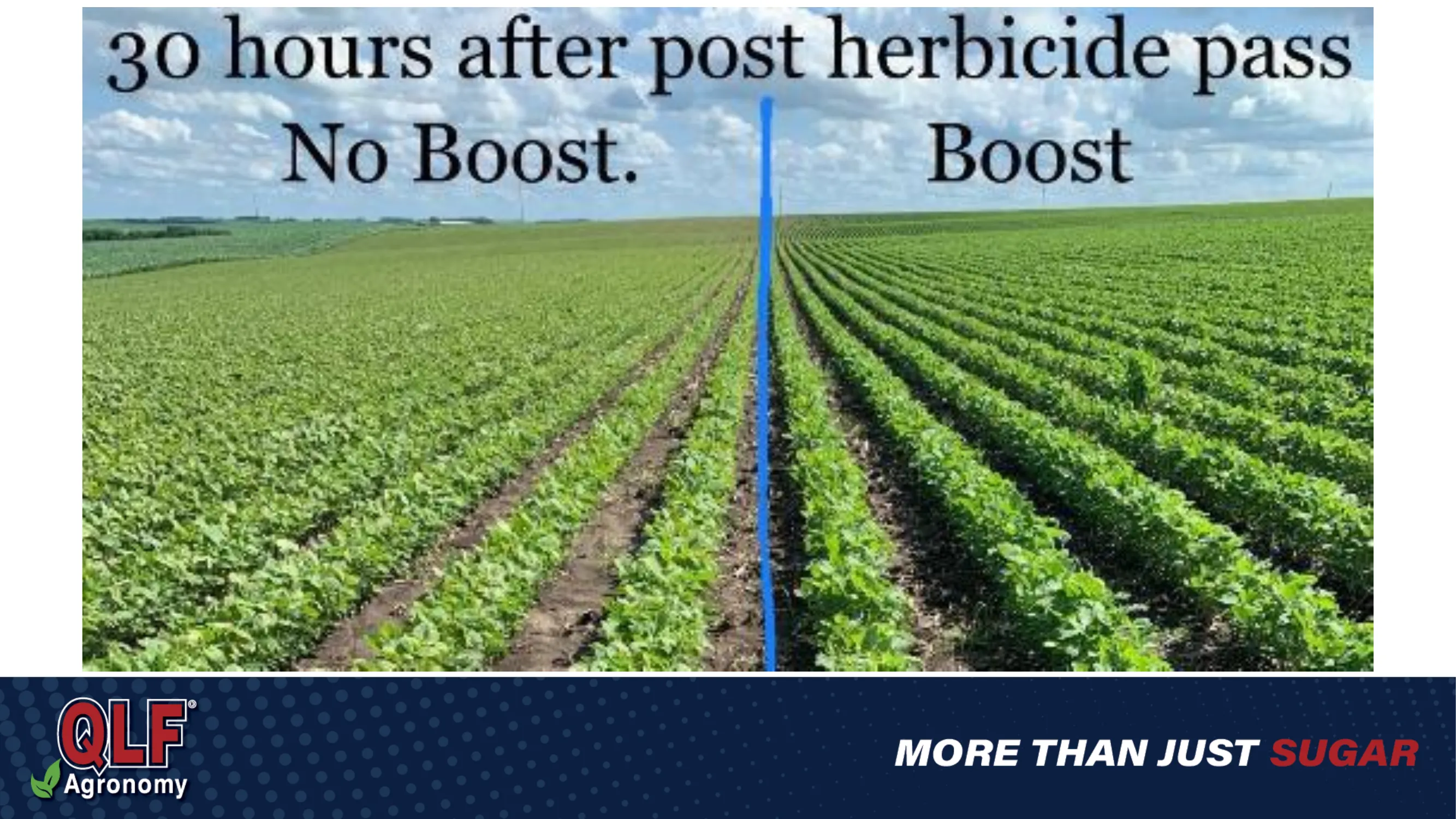
Aerial imagery and ground-level observations revealed striking visual differences between treated and untreated areas. Fields treated with stress mitigation products showed:
- Darker green coloration indicating higher chlorophyll content
- More uniform canopy with consistent plant height
- Faster recovery after herbicide application (visible within 30 hours)
[Image blocked: Plant Health Visual Comparison - Enlist Application]
[Image blocked: Plant Health Visual Comparison - Flexstar Application]
The side-by-side comparisons show clear differences in plant vigor. The treated side exhibits healthier, more robust growth with minimal herbicide damage, while the untreated control shows visible stress symptoms including yellowing and stunted growth.
Leaf-Level Analysis
Close examination of individual leaves revealed significant differences in stress response:
[Image blocked: Leaf Comparison Study]
- Control leaves showed discoloration, necrotic spots, and irregular edges
- Treated leaves maintained deep green color, smooth edges, and healthy tissue structure
This visual evidence supports the yield data, demonstrating that stress mitigation products provide real, measurable protection at the cellular level.
The Critical Role of pH in Pesticide Effectiveness
Why pH Matters: The Half-Life Connection
One of the most overlooked factors in pesticide effectiveness is water pH. The pH of your spray solution dramatically affects how long active ingredients remain effective. Research from Purdue University Extension (PPP-86) reveals startling differences:
[Image blocked: pH Impact on Pesticide Half-Life]
| Product Type | Half-Life at pH 9 | Half-Life at pH 7 | Half-Life at pH 5 |
|---|---|---|---|
| Herbicide | 10 minutes | 17 hours | 16 days |
| Fungicide | 2 minutes | 3 hours | 10 hours |
| Insecticide | 24 hours | 10 days | Stable |
Key Insight: At high pH (alkaline water), herbicides break down in as little as 10 minutes. At neutral to slightly acidic pH, the same herbicide remains active for 17 hours or longer.
Optimal pH Ranges for Spray Applications
pH 3.5 – 6: Ideal for most applications
- Spray within 12-24 hours of mixing
- Not suitable for sulfonylurea herbicides (these require higher pH)
pH 6 – 7: Acceptable for most products
- Spray within 1-2 hours for best results
- Good compromise for tank mixes with multiple products
pH > 7: Problematic for many pesticides
- Spray immediately to avoid degradation
- Consider pH adjusters or buffering agents
How Liquid Carbon-Based Fertilizers Act as pH Buffers
Products like BOOST have a pH range of 3.3 – 5.6, which makes them effective pH buffers when added to spray solutions. Here's how they work:
-
Lowering Spray Solution pH: When added to alkaline water, L-CBF products reduce the overall pH of the tank mix, extending pesticide half-life.
-
Reducing Ammonia Volatilization: BOOST lowers pH, which reduces the volatilization of ammonia from nitrogen applications. This means more nitrogen stays in the soil where crops can use it, rather than escaping to the atmosphere.
-
Improving Pesticide Efficacy: By maintaining optimal pH, these products ensure that herbicides, fungicides, and insecticides perform as intended, reducing the need for reapplication.
[Image blocked: pH Buffering Demonstration]
The image above shows pH meter readings demonstrating the buffering effect. Adding BOOST to a high-pH spray solution (6.24) reduces it to a more optimal range (3.02), significantly extending pesticide effectiveness.
Practical Applications: Implementing Stress Mitigation on Your Farm
When to Apply Stress Mitigation Products
Post-Herbicide Applications: The most common timing is immediately after or tank-mixed with post-emergence herbicides. This provides protection during the most vulnerable period.
Pre-Stress Applications: Some farmers apply stress mitigation products 24-48 hours before anticipated stress events (herbicide applications, heat stress, or drought).
Recovery Applications: If crops show visible stress symptoms, a follow-up application can accelerate recovery and minimize yield loss.
Tank Mix Compatibility
Liquid carbon-based fertilizers are generally compatible with most herbicides, fungicides, and insecticides. However, always:
- Conduct a jar test before mixing large quantities
- Follow label instructions for all products in the tank mix
- Add products in the correct order (typically: water, then fertilizers, then pesticides)
- Monitor pH of the final spray solution
Application Rates and Timing
Based on the Beck's research and agronomic recommendations:
- Standard rate: 1-2 gallons per acre for liquid carbon-based fertilizers
- Timing: Tank-mixed with post-emergence herbicides or applied within 24 hours
- Frequency: Can be applied multiple times during the growing season as needed
Return on Investment: Making the Business Case
Breaking Down the Economics
Let's examine the ROI using data from the Beck's study (based on $10.33/bu soybeans):
Scenario: 1,000-Acre Soybean Operation
| Treatment | Yield Increase | Revenue Increase | Product Cost* | Net Profit |
|---|---|---|---|---|
| BOOST 2 gal/acre | +3.0 bu/A | +$30.99/acre | ~$7.70/acre | +$23.29/acre |
| Total (1,000 acres) | +3,000 bu | +$30,990 | ~$7,700 | +$23,290 |
Note: Product costs vary by region and volume. Consult with your local dealer for current pricing.
Additional Benefits Beyond Yield
The ROI calculation above only accounts for direct yield increases. Additional benefits include:
- Reduced reapplication costs: Better pesticide efficacy means fewer trips across the field
- Improved crop quality: Healthier plants often produce higher-quality grain
- Risk mitigation: Stress protection provides insurance against environmental variability
- Soil health improvements: Enhanced microbial activity benefits long-term soil fertility
Regional Performance: State-by-State Results
The Beck's study tracked return on investment across four states, revealing how stress mitigation products perform in different growing environments:
Indiana
- BOOST ROI: +$36.72/acre
- Strong performance in Indiana's diverse soil types
Central Illinois
- BOOST ROI: +$5.73/acre
- Moderate gains in high-fertility soils
Ohio
- BOOST ROI: +$22.26/acre
- Consistent results across variable weather conditions
Nebraska
- BOOST ROI: +$27.42/acre
- Excellent performance in drier western conditions
Key Takeaway: Stress mitigation products delivered positive ROI in all tested locations, though results varied based on local conditions. The average return was $23-$27 per acre across most regions.
Best Practices for Maximizing Crop Safety
1. Test Your Water pH
Before every spray application, test the pH of your water source. Well water, pond water, and municipal water can have vastly different pH levels. Invest in a simple pH meter (available for $50-$150) to monitor your spray solution.
2. Time Applications Appropriately
Apply herbicides during optimal conditions:
- Temperature: 60-85°F for most products
- Wind: Less than 10 mph to reduce drift
- Time of day: Early morning or evening when temperatures are moderate
3. Monitor Crop Growth Stage
Crops are most vulnerable to herbicide stress at certain growth stages. For soybeans, the V3-V5 stage (3-5 trifoliate leaves) is particularly sensitive. Consider stress mitigation products during these critical windows.
4. Use Quality Water Sources
Hard water, high-pH water, and water with high mineral content can all reduce pesticide effectiveness. If your water quality is poor, consider:
- Water conditioning agents
- pH adjusters
- Liquid carbon-based fertilizers as buffers
5. Keep Detailed Records
Track which fields receive stress mitigation products, application rates, timing, and subsequent yield results. Over time, this data will help you refine your strategy and identify which fields benefit most.
Conclusion: Science-Backed Strategies for Better Yields
The research is clear: herbicide stress is real, measurable, and costly. However, farmers now have proven tools to mitigate this stress and protect yield potential. Liquid carbon-based fertilizers offer a multi-faceted approach by:
- Providing readily available energy and nutrients during stress periods
- Buffering spray solution pH to maximize pesticide effectiveness
- Stimulating soil biology for improved nutrient cycling
- Reducing ammonia volatilization from nitrogen applications
Field trials across multiple states demonstrate consistent yield improvements of 2.5-3.0 bushels per acre with returns on investment ranging from $16 to $37 per acre. For a typical 1,000-acre operation, this translates to $16,000 to $37,000 in additional revenue annually.
Beyond the immediate financial returns, stress mitigation strategies contribute to long-term soil health, reduce environmental impact through more efficient pesticide use, and provide risk management in an era of increasing weather variability.
As you plan your upcoming season, consider incorporating stress mitigation products into your crop protection program. The science supports it, the economics justify it, and your crops will thank you with healthier growth and higher yields.
Questions or Want to Learn More?
Contact your local Hennings Enterprises agronomist to discuss stress mitigation strategies for your operation. Our team can help you:
- Evaluate your water quality and pH management needs
- Design a stress mitigation program tailored to your crops and conditions
- Source quality liquid carbon-based fertilizers and application equipment
- Interpret field trial results and adapt strategies to your farm
Ready to protect your yield potential? Request a quote [blocked] or contact us [blocked] today.
References
- Beck's Practical Farm Research - 2025 Stress Mitigation Study, Multi-Location Soybean Trials
- Purdue University Extension PPP-86: "The Impact of Water Quality on Pesticide Performance"
- QLF Agronomy - Liquid Carbon-Based Fertilizer Research and Field Demonstrations
This article is for educational purposes and does not constitute specific agronomic recommendations. Always follow product labels and consult with certified crop advisors for farm-specific guidance.